
About
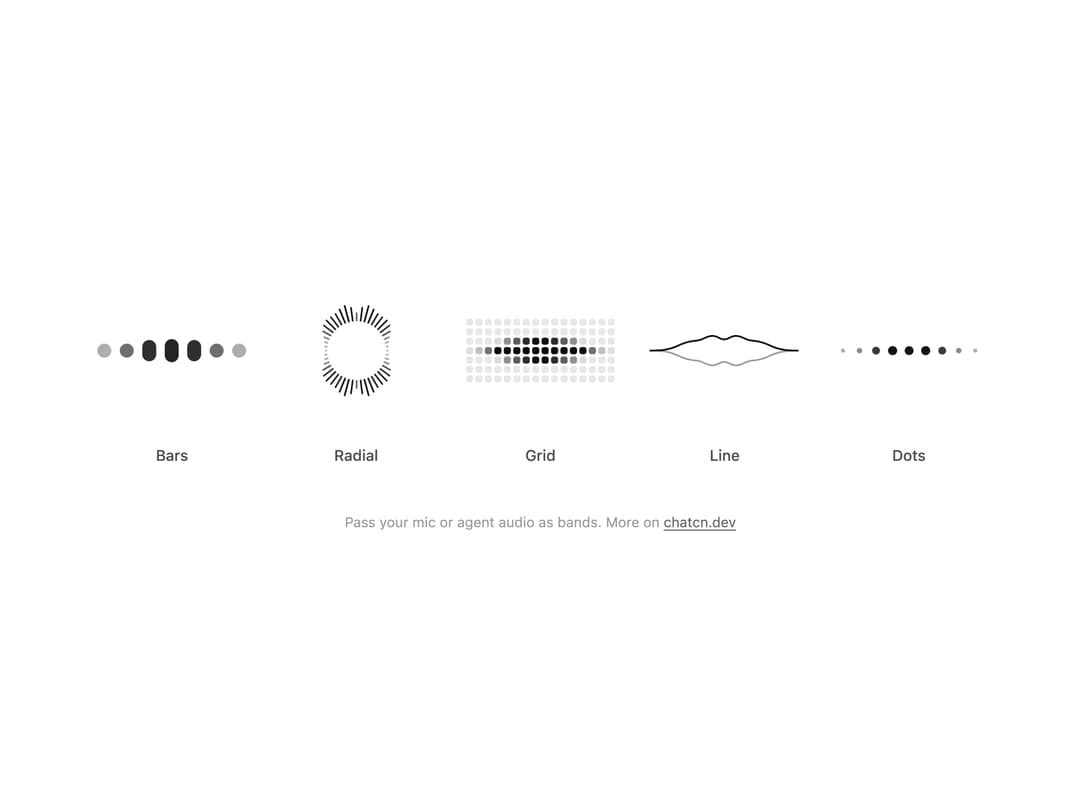
Five canvas audio visualizers (bars, radial, grid, line, dots) for voice agents that read live frequency bands from a mic or agent audio.
Built with React and Tailwind. Copy the prompt and paste it into Claude Code, Cursor or Lovable: your agent adds Audio Visualizer to your project and fits it to your theme.
Code
How Audio Visualizer is used: the demo's code. The component's own source comes with a free account.
Usage.tsx
"use client"

import * as React from "react"
import { AudioVisualizer, AudioVisualizerVariant } from "@/components/ui/audio-visualizer"

/* -------------------------------------------------------------------------------------------------
 * Simulated speech levels
 *
 * Demos, tests and design reviews need a voice without a microphone. A random walk reads as
 * noise; speech has syllables (about four a second), short gaps between words and a slower phrase
 * contour. This generator models those three layers so a meter driven by it looks like someone
 * talking.
 * -----------------------------------------------------------------------------------------------*/

interface ChatcnSpeechLevelOptions {
  /** Changes the rhythm, so two voices never move in lockstep. Default 1. */
  seed?: number
  /** Syllables per second. Default 4.2. */
  syllableRate?: number
  /** Peak level from 0 to 1. Default 0.8. */
  loudness?: number
  /** Level while silent, so a live meter never looks dead. Default 0.02. */
  floor?: number
}

interface ChatcnSpeechLevel {
  /** Current smoothed level from 0 to 1. Call it every frame. */
  getLevel: () => number
  /** `count` band levels from 0 to 1, lowest first, with two moving formant humps. */
  getBands: (count: number) => Float32Array
  setSpeaking: (speaking: boolean) => void
  isSpeaking: () => boolean
}

const fract = (x: number) => x - Math.floor(x)

const hash = (n: number, seed: number) => fract(Math.sin(n * 12.9898 + seed * 78.233) * 43758.5453)

/** A speech-like level source you start and stop. Framework free; see `useChatcnSimulatedLevel`. */
function createChatcnSpeechLevel(options: ChatcnSpeechLevelOptions = {}): ChatcnSpeechLevel {
  const { seed = 1, syllableRate = 4.2, loudness = 0.8, floor = 0.02 } = options
  let speaking = false
  let envelope = floor
  let last = 0
  let phase = 0
  let syllable = 0

  const target = (t: number) => {
    if (!speaking) return floor + 0.01 * (0.5 + 0.5 * Math.sin(t * 7.3 + seed))
    const k = Math.floor(phase)
    const u = phase - k
    let amp = 0.45 + 0.55 * hash(k, seed)
    // Roughly one slot in six is the gap between words.
    if (hash(k * 1.7 + 3, seed) < 0.17) amp *= 0.08
    const shape = u < 0.22 ? (u / 0.22) ** 0.7 : (1 - (u - 0.22) / 0.78) ** 1.5
    const contour = 0.78 + 0.22 * Math.sin(t * 0.55 + seed * 2)
    return loudness * contour * (0.12 + 0.88 * amp * shape)
  }

  const getLevel = () => {
    const now = performance.now()
    if (now - last < 8) return envelope
    const dt = last ? Math.min(0.1, (now - last) / 1000) : 1 / 60
    last = now
    const t = now / 1000
    // Syllable length jitters by up to 40 percent, so the rhythm never ticks like a clock.
    const k = Math.floor(phase)
    phase += dt * syllableRate * (0.8 + 0.4 * hash(k * 3.1, seed))
    syllable = k
    const goal = target(t)
    const rate = goal > envelope ? 28 : 9
    envelope += (goal - envelope) * (1 - Math.exp(-rate * dt))
    return envelope
  }

  const getBands = (count: number) => {
    const level = getLevel()
    const out = new Float32Array(Math.max(0, count))
    const t = performance.now() / 1000
    // Formants move per syllable: vowels change where the energy sits.
    const f1 = 0.16 + 0.1 * hash(syllable * 2.3, seed)
    const f2 = 0.42 + 0.18 * hash(syllable * 5.9 + 1, seed)
    for (let i = 0; i < count; i++) {
      const x = count === 1 ? 0.5 : i / (count - 1)
      const bump = Math.exp(-(((x - f1) / 0.14) ** 2)) + 0.75 * Math.exp(-(((x - f2) / 0.2) ** 2))
      const air = 0.18 * (1 - x)
      const flicker = 0.85 + 0.15 * Math.sin(t * 23 + i * 1.9 + seed)
      out[i] = Math.min(1, level * (bump + air) * flicker * 1.15)
    }
    return out
  }

  return {
    getLevel,
    getBands,
    setSpeaking: (next) => {
      speaking = next
    },
    isSpeaking: () => speaking,
  }
}

/**
 * Simulated speech levels for demos without a microphone. Returns stable getters for voice
 * components, so the meter animates without re-rendering. Pass `speaking` to start and stop.
 *
 * `<VoiceOrb state="speaking" level={assistant.getLevel} />`
 */
function useChatcnSimulatedLevel(
  speaking: boolean,
  options: ChatcnSpeechLevelOptions = {},
): Pick<ChatcnSpeechLevel, "getLevel" | "getBands"> {
  const [sim] = React.useState(() => createChatcnSpeechLevel(options))
  React.useEffect(() => sim.setSpeaking(speaking), [sim, speaking])
  return React.useMemo(() => ({ getLevel: sim.getLevel, getBands: sim.getBands }), [sim])
}

const FIT_CSS = "html,body{overflow:hidden}[data-fit-small] [data-fit-hide]{display:none!important}"

/**
 * 21st shows a demo in a small frame: about 674 by 421 on a component page, 358 by 224 on a
 * phone and 245 by 139 on a profile card. A demo taller than its frame gets scrollbars, which
 * render white on dark pages. FitFrame fills the frame exactly instead.
 *
 * - "scale": the content shrinks until it fits, centered. For visuals such as orbs.
 * - "crop": the content stays at full size from the top and fades out at the bottom. For text
 *   that streams in, where a changing scale would make the page breathe.
 *
 * Anything marked `data-fit-hide` (state buttons, the chatcn.dev line) drops out in frames
 * shorter than `hideBelow`, so a profile card shows the visual alone.
 */
function FitFrame({
  children,
  mode = "scale",
  hideBelow = 360,
}: {
  children: React.ReactNode
  mode?: "scale" | "crop"
  hideBelow?: number
}) {
  const content = React.useRef<HTMLDivElement>(null)
  const [cropped, setCropped] = React.useState(false)

  React.useLayoutEffect(() => {
    const el = content.current
    if (!el) return
    const measure = () => {
      const vw = window.innerWidth
      const vh = window.innerHeight
      el.toggleAttribute("data-fit-small", vh < hideBelow)
      // Layout sizes ignore the transform, so measuring never feeds back.
      const w = Math.max(el.offsetWidth, el.scrollWidth)
      const h = Math.max(el.offsetHeight, el.scrollHeight)
      const scale = mode === "scale" ? Math.min(1, vw / w, vh / h) : 1
      el.style.transform = scale < 1 ? `scale(${scale})` : ""
      setCropped(mode === "crop" && h > vh + 1)
    }
    measure()
    const observer = new ResizeObserver(measure)
    observer.observe(el)
    window.addEventListener("resize", measure)
    return () => {
      observer.disconnect()
      window.removeEventListener("resize", measure)
    }
  }, [mode, hideBelow])

  const fade = "linear-gradient(to bottom, #000 calc(100% - 40px), transparent)"
  return (
    <div
      className="flex w-full justify-center overflow-hidden"
      style={{
        height: "100dvh",
        alignItems: mode === "crop" ? "flex-start" : "center",
        maskImage: cropped ? fade : undefined,
        WebkitMaskImage: cropped ? fade : undefined,
      }}
    >
      <style>{FIT_CSS}</style>
      <div
        ref={content}
        className="w-full shrink-0"
        style={{ transformOrigin: mode === "crop" ? "top center" : "center" }}
      >
        {children}
      </div>
    </div>
  )
}

const VARIANTS: { variant: AudioVisualizerVariant; label: string }[] = [
  { variant: "bars", label: "Bars" },
  { variant: "radial", label: "Radial" },
  { variant: "grid", label: "Grid" },
  { variant: "line", label: "Line" },
  { variant: "dots", label: "Dots" },
]

/** The line under each 21st demo that points back to the kit. */
function MoreOn({ slug, children }: { slug: string; children: React.ReactNode }) {
  return (
    <p data-fit-hide className="text-[0.75rem]/[1rem] text-(color:--chatcn-fg-faint) text-center text-balance">
      {children}{" "}
      <a
        href={`https://chatcn.dev/docs/components/${slug}`}
        target="_blank"
        rel="noopener"
        className="text-(color:--chatcn-fg-subtle) hover:text-(color:--chatcn-fg) underline underline-offset-2"
      >
        chatcn.dev
      </a>
    </p>
  )
}

/** Five forms of one voice, driven by simulated speech. Pass your mic or agent audio as `bands`. */
export default function AudioVisualizerDemo() {
  const agent = useChatcnSimulatedLevel(true, { seed: 7, loudness: 0.85 })
  return (
    <FitFrame>
      <div className="flex w-full flex-col items-center justify-center gap-10 p-6">
        <div className="grid w-full max-w-3xl grid-cols-2 gap-x-6 gap-y-10 sm:grid-cols-3 lg:grid-cols-5">
          {VARIANTS.map(({ variant, label }) => (
            <div
              key={variant}
              // A small frame keeps two of the five forms.
              data-fit-hide={variant === "bars" || variant === "radial" ? undefined : true}
              className="flex flex-col items-center gap-4"
            >
              <div className="grid h-32 place-items-center">
                <AudioVisualizer
                  variant={variant}
                  state="speaking"
                  bands={agent.getBands}
                  className={variant === "radial" ? "size-28" : "h-14 w-32"}
                />
              </div>
              <span className="text-[0.8125rem]/[1.25rem] text-(color:--chatcn-fg-muted) font-medium">{label}</span>
            </div>
          ))}
        </div>
        <MoreOn slug="audio-visualizer">Pass your mic or agent audio as bands. More on</MoreOn>
      </div>
    </FitFrame>
  )
}
More by Aadi
View all
Stat Card
45
Dither Orb
23
Voice Orb
19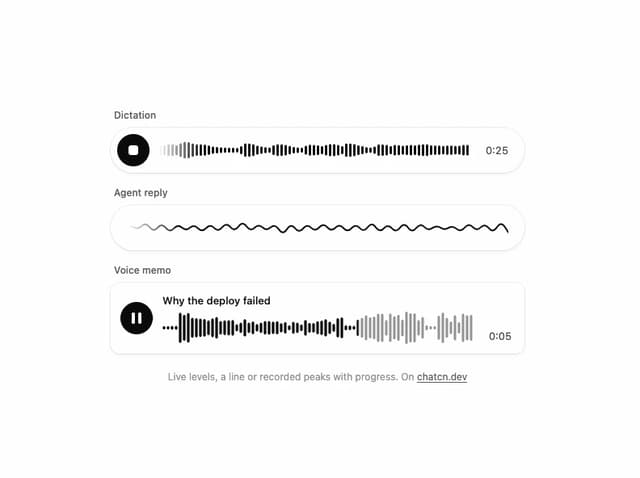
Waveform
15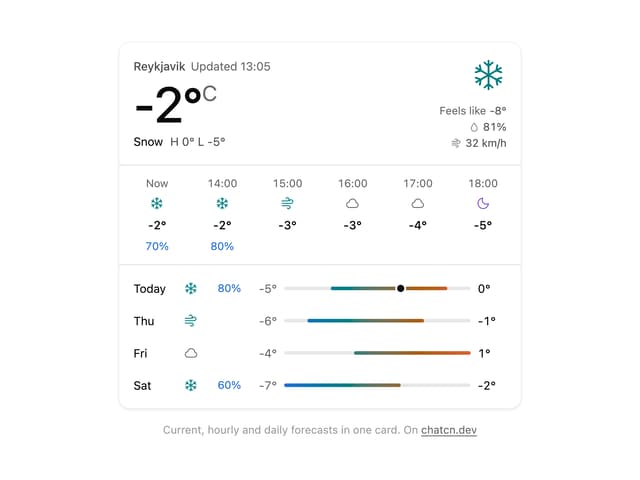
Weather Card
14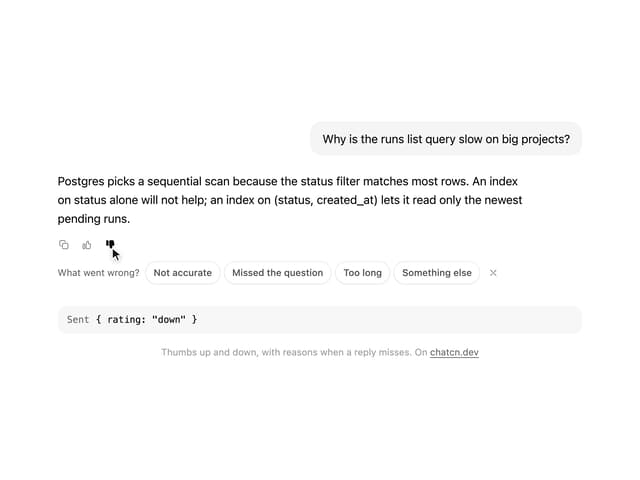
Message Feedback
13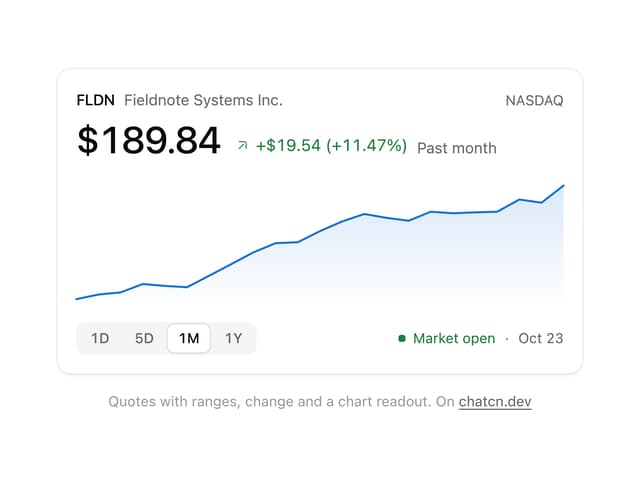
Ticker Card
13
Voice Controls
12